
Amy Anderson, BSChE, PE, CFEI
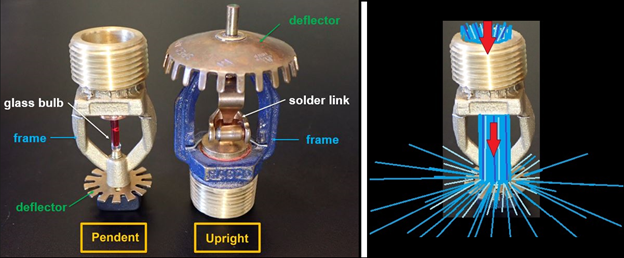
A fire sprinkler has three primary parts: frame, deflector, and heat-responsive element. The heat-responsive element can be a glass bulb or a fusible link. The heat-responsive element holds a sealing assembly in place, which holds back water (on a wet system). To the right of the labeled sprinklers is a depiction of how a pendant sprinkler would flow and disperse water once the heat-responsive element fuses in response to heat.
Here are those basic parts, shown on a pendant glass bulb sprinkler and an upright fusible link (aka “solder link) sprinkler:
Heat-Responsive Elements
Glass Bulbs are similar looking across the board. The two main variations of the bulbs are response time (standard or quick [fast] response) and temperature rating. A thinner bulb will be a quick response; a thicker bulb will be a standard response.
Glass bulbs come in different colors, but that’s not for coordinating with the décor; the color indicates the temperature rating of the bulb. Orange is 135°F, red is 155°F, yellow is 175°F, green is 200°F, blue is 286°F, and purple is 360°F. Of these, the most common are red, green, and blue.
Don’t let a glass bulb’s delicate appearance fool you; the minimum crush strength of a quick response bulb is commonly around 500 lbs. Standard response bulbs have a higher minimum crush strength, which can approach 1000 lbs. (“Crush strength” refers to the maximum compressive force a material can withstand before breaking). As incredibly strong as glass bulbs are, the fusible link type of operating element is even more robust.
Fusible Links
In today’s fusible link sprinklers, there are different styles, but they all have in common heat-sensitive parts that will give way when exposed to sufficient heat.
On some of the classic fusible link sprinkler models, the linkage extends a good bit outside of the frame. The more compact design of modern fusible elements makes them less susceptible to mechanical damage than their predecessors.
In general, the larger the sprinkler, the more likely the heat-responsive element will be a fusible link instead of a glass bulb. At mid-size and smaller sprinklers, a mixture of glass bulb and fusible link sprinklers is available. Larger sprinklers are more often offered with fusible links, though there are exceptions. On either end of the heat-responsive element, there is the sealing assembly (pipe side) and a load screw (deflector side).
Deflectors will have different designs based on a sprinkler’s orientation or special use, such as attic sprinklers or concealed space sprinklers.
A couple of the parts that are less known include the wrench boss and kick spring. Included in parentheses below are some of the different names for these parts.
A wrench boss (wrench flat) is a flat face on or near the bottom of the frame, above the threads, where the sprinkler wrench is placed when installing the sprinkler.
A kick spring (lodgement wire) is a wire-like spring intended to ensure the cap clears the waterway and frame when the sprinkler activates. It “kicks” the assembly out to the side. Not all sprinklers will have these.
I hope that taking a closer look at some of the parts of sprinklers enhances your appreciation of the design and intricacies of these overlooked and not well-understood fire sentries.
If you have any questions or would like to speak with the author, please contact her at 803-732-660 ofc or 864-505-8452 cell. You may also contact her at amy@warrenforensics.com.
This newsletter is a publication of Southern Loss Association, Inc., P.O. Box 421564, Atlanta, GA 30342. The articles written in the newsletter are in a general format and are not intended to be legal advice applicable to any specific circumstances. Legal opinions may vary when based on subtle factual differences. All rights reserved.